The Quiet After the Eleventh: A Five-Minute Landing for Remembrance Sunday
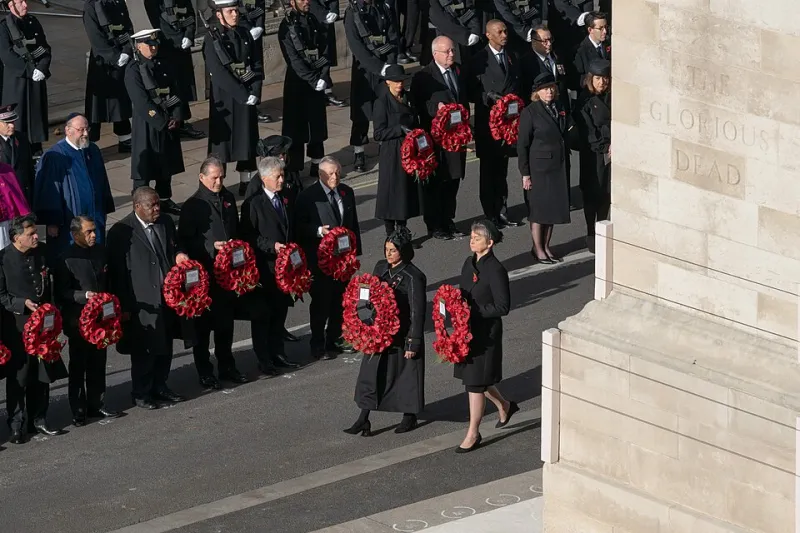
Photo: Department for Culture, Media & Sport, CC0, via Wikimedia Commons
On Remembrance Sunday 2026, a town centre can go from ceremony to ordinary in about ten minutes. The Last Post fades. The wreaths are laid. Someone's phone buzzes. The crowd loosens and drifts towards the car park, the bus stop, the Sunday roast. And then, often, comes the odd bit: a flatness, a rawness, a restlessness you didn't expect. Maybe you cried and felt embarrassed. Maybe you didn't cry and felt guilty. Maybe you just want to go home and sit down.
None of that means you did remembrance wrong. The two-minute silence is tidy. The feelings afterwards rarely are. At Take Five, we are wary of turning that aftermath into a wellness project. You do not need to journal your way through the Cenotaph coverage or optimise your gratitude. Sometimes you need five quiet minutes and permission to feel a bit strange.
The quiet isn't empty
There is a particular hush after a public ceremony. The bugle has stopped, but your ears are still listening for it. The town looks the same — the bakery, the charity shop, the bus shelter — but it feels briefly staged. People speak in slightly lower voices, then someone laughs, then everyone remembers to be normal again.
If you feel raw in that gap, you are not being fragile. Remembrance touches all sorts of things: family history, old losses, news from conflicts, the simple fact of being alive when others are not. It can also touch nothing at all, and that is allowed too. The point is not to audit your reaction. The point is to land.
One breath, no performance
Find somewhere to sit or stand still — the car, a bench, the kitchen table, the edge of the bath if that is where the house is quietest. Put both feet on the floor. Let one breath be slightly slower than usual. Not a big yoga breath. Not a count that makes you cross. Just an in-breath, and an out-breath that takes its time.
If counting helps, try in for four and out for six. If counting irritates you, skip it. This is not a breathing exercise to master. It is one breath that says: I am still here, and I do not have to rush into the rest of the day.
One grounding detail
Look for one ordinary thing and give it your full attention for a moment. The grain of a wooden bench. The cold zip of your coat. The sound of a bus idling. The smell of wet leaves. The way the light sits on a windowsill in November.
Name it silently, or say it under your breath. 'Cold zip.' 'Wet leaves.' 'Bus engine.' That is enough. Grounding is not distraction. You are not trying to whisk yourself away from the ceremony. You are giving your body a small, solid fact to stand on while the feelings do whatever they need to do.
If tears come, let them. If nothing comes, let that be. The five minutes are not a test.
One plain note-to-self
Take a scrap of paper or the notes app on your phone. Write one plain sentence. Not an affirmation. Not a slogan. Something true and unglamorous.
'I am allowed to feel odd today.'
'I will ring someone tomorrow.'
'I don't have to make this mean anything yet.'
'I am not going to watch the news for another hour.'
Keep it short enough to believe. The sentence is not a contract. It is a small handrail for the next hour. If you write nothing, that is also fine. The note is optional; the pause is the point.
If the quiet feels too heavy
Remembrance can stir real grief — for people who died in conflict, for family members, for friends, for losses that have nothing to do with war. It can also stir anxiety, anger or a sense of distance from the people around you. You do not have to carry that alone, and you do not have to wait until it becomes a crisis to speak to someone.
A cup of tea with a friend counts. A phone call to family counts. Local community groups, faith spaces, veterans' organisations and the Royal British Legion can be part of the picture. Cruse Bereavement Support offers help after a death, and Samaritans are on 116 123, free, 24 hours a day. If you are at immediate risk, call 999. If things feel unmanageable but not urgent, your GP can help, and NHS 111 can point you towards the right service.
This five-minute reset is not therapy, and it is not a substitute for support. It is just a way to be kind to yourself in the gap between the ceremony and the rest of Sunday.
A small ending
When the five minutes are up, end them. Stand up. Put the kettle on. Walk to the bus stop. Text someone to say you got home. You do not need to report back to yourself about how the reset went. There is no streak to keep.
Remembrance is not a wellness challenge. It is a human thing, messy and ordinary. The silence lasts two minutes. The quiet afterwards can last longer. Five minutes of landing is enough for now.